Belcarra Garden Club
BC, Canada
Tomato Tidbits
It was fun researching this tasty article, especially since my veggie garden is only four pots on the deck, designated for snack-sized tidbits! Perhaps I can claim double bonus here though, seeing as tomatoes can be thought of as either a vegetable or a fruit. Botanically, a fruit is any plant part that developed from a flower and has seeds inside it. A vegetable is simply a plant part eaten with the main part of the meal. There was even a court case on this confusion! I think this comment that I read on “Reddit” really puts it all in perspective. “Knowledge is knowing a tomato is a fruit. Wisdom is knowing to not put one in a fruit salad.”
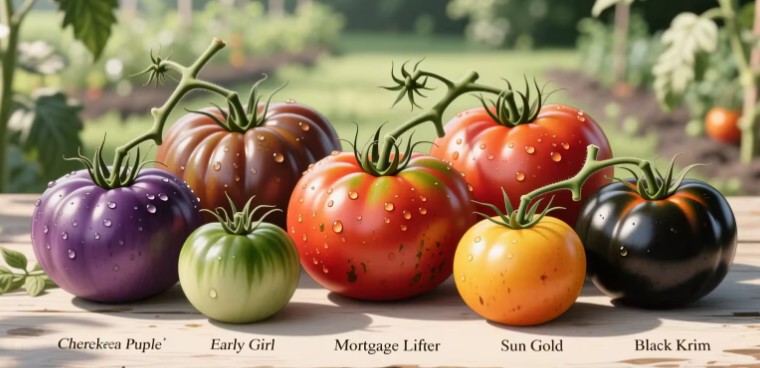
AI photo from spice.alibaba.com
HISTORY
You may know that tomatoes were once called “love apples” for their supposed aphrodisiac qualities. Did you know they were also known as “poison apples” at one point? In the 1700s, rich colonists became ill after eating them, but pewter serving dishes (causing lead poisoning) appear to have been the real culprit.
The original wild tomatoes were grown in the Andes Mountains of South America and were the size of peas! The plant slowly migrated north. The name “tomatl” means “swelling fruit” in the Aztec Nahuatl language. By the 1500s, tomatoes were commonly grown. The Spanish conquistadors brought tomato seeds back to Europe. The Spanish and Italians embraced them, but Northern Europe did not. Italians called them “pomodoro” (golden apple).
In 1889, the Margherita pizza was created in Naples, Italy, featuring red tomatoes, white mozzarella, and green basil (the colours of the Italian flag). In 1897, Joseph Campbell formulated condensed tomato soup. Today, there are over 10,000 varieties of tomatoes grown worldwide.
HEIRLOOM TOMATOES
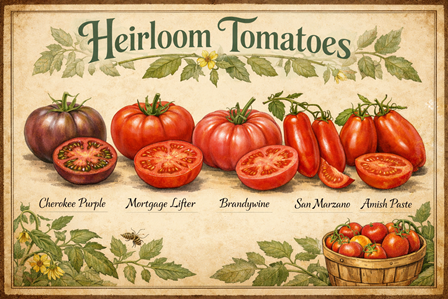
You often hear the term “heirloom tomatoes.” These are open-pollinated, which means the seeds can be saved for the following year. The most famous are Cherokee Purple (supposedly from the Cherokee Nation, 1800s), Radiator Charlie’s Mortgage Lifter (cross-bred during the 1930s Depression), Brandywine (tied to Amish communities in Pennsylvania), San Marzano (traditionally used in authentic Neapolitan pizza), and Amish Paste (traced to one of the oldest Amish communities in the U.S.). Non-heirloom seeds are hybrids, bred for traits such as disease resistance and higher yields.
SAVING SEEDS
Unlike other vegetables, tomato seeds must undergo fermentation. In nature, the seeds rot on the ground, so we must mimic this. Squeeze out the seeds, along with the surrounding gel, into a small jar. Add a little water if the juice doesn’t cover the seeds. Then cover the jar with a paper towel and an elastic band to keep out fruit flies. Place it in a warm spot, out of direct sunlight, for 3 to 5 days. Swirl it once a day. It will begin to look a little gross, with mould on top and a sour smell—but that’s a good sign! The fermentation breaks down the gel and helps eliminate seed-borne diseases. Next, add a cup of water and stir vigorously. Viable seeds will sink to the bottom. Carefully pour off the top layer. Strain and thoroughly rinse the remaining seeds. Dry them completely by spreading them out on parchment paper. Never use paper towels—the seeds will stick permanently! Let them dry for 1–2 weeks, until they are hard. Store them in an envelope or glass jar (with a label!) in a cool, dark place until next spring. Unless these are heirloom varieties, you can’t guarantee the same qualities.
GROWING TOMATOES IN BRITISH COLUMBIA
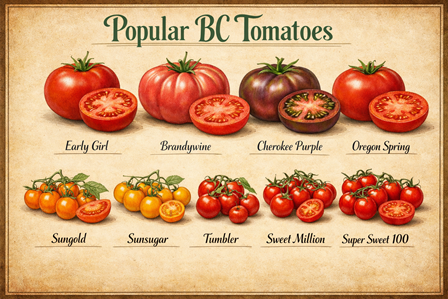
Growing tomatoes in British Columbia comes with its own challenges due to cooler nights and wetter conditions. The best varieties are early-maturing and disease-resistant. There are several popular garden shop varieties. (The information here is from an AI search, but you’ll find that each website has a few different recommendations!) Sungold cherry tomatoes are number one. These sweet, golden-orange tomatoes ripen in just 55–60 days and produce until the first frost. Early Girl produces baseball-sized slicing tomatoes, maturing in about 50 days. Tumbler has been bred to cascade over hanging baskets and is determinate, so it stays compact. Sweet Million and Super Sweet 100 are classic red cherry tomatoes; they are disease-resistant and rarely crack after unexpected rain. Oregon Spring was developed for our cooler Northwest climate; this slicer is large and nearly seedless. Brandywine is an heirloom beefsteak tomato. Cherokee Purple, also an heirloom, is large with a unique smoky flavour and dark colour. Roma tomatoes have a low seed count, making them ideal for sauces.
Les is truly a Tomato King. He has been saving seeds for so many years that they are probably now classified as “Belcarra Beauties” or “Belcarra Bounty”! My best friend highly recommends ‘Sunsugar’ cherry tomatoes. (Note from “Reddit: Sungold is #1 for flavour but prone to splitting. Sunsugar is also tasty but less compromised with rain or watering consistency.)
JUST A FEW TOMATO TIPS
Useful tips include knowing if your chosen variety is determinate or semi-determinate (more compact) or indeterminate (grows long vines). Decide on your trellis, stake, or tomato cage at the time of planting. Choose a spot with 6 or more hour of sunshine. Protect tomatoes from too much rain and water the soil, not the leaves.
Garden folklore suggests planting by the moon!
Another tip is talking to your plants—but honestly, doesn’t every gardener do that?
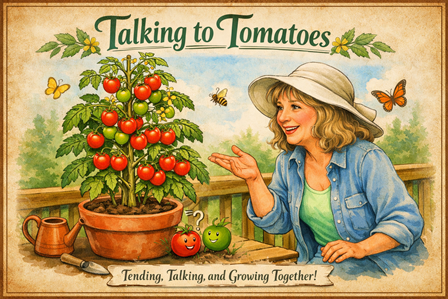
Enjoy your tomatoes—and don’t forget to have a chat with them while you’re at it!
Disclaimer: The illustrations were created by conversing with CoPilot AI.
Related Links:
A BIT OF TOMATO HISTORY
History of the tomato
https://www.smithsonianmag.com/history/how-the-misrepresentation-of-tomatoes-as-stinking-poison-apples-that-provoked-vomiting-made-people-afraid-of-them-for-more-than-200-years-863735/
Campbell Soup information
https://www.smithsonianmag.com/innovation/how-campbell-soup-turned-new-jersey-into-tomato-growing-state-180979397/?itm_source=related-content&itm_medium=parsely-api
Tomatoes: vegetable or fruit?
https://yardandgarden.extension.iastate.edu/faq/tomato-fruit-or-vegetable
Tomatoes: vegetable or fruit? Court case
https://en.wikipedia.org/wiki/Nix_v._Hedden
GROWING TOMATOES
Growing Tomatoes in British Columbia
https://growersguide.ca/blog/when-to-plant-tomatoes-bc
https://susanhomecare.com/how-to-grow-tomatoes-vancouver/
https://www.bcecoseedcoop.com/blogs/resources-for-growers/tomato-tips
https://www2.gov.bc.ca/gov/content/industry/agriculture-seafood/agriservice-bc/production-guides/vegetables/tomatoes
Heirloom Tomatoes
https://extension.msstate.edu/blogs/extension-for-real-life/what-are-heirloom-tomatoes
Saving tomato seeds
https://www.theprairiehomestead.com/2022/08/how-to-save-tomato-seeds.html
https://www.thespruce.com/how-to-save-tomato-seeds-1403292
Buying tomato seeds
https://www.westcoastseeds.com/collections/tomato-seeds
https://metchosinfarm.ca/collections/tomato-seeds
https://www.bcecoseedcoop.com/collections/tomato
https://www.artsnursery.com (Just search for “tomatoes”)
Tomato Varieties
Nice photos and descriptions of 44 tomatoes in USA zones 2 to 10
https://www.thespruce.com/tomato-varieties-7505096
More nice photos and descriptions (USA) of 24 tomatoes
https://mygardenlife.com/what-to-grow/favorite-tomato-varieties
