Belcarra Garden Club
BC, Canada
Poppies for Remembrance Day
by Nora Boekhout

image from Seedscape
With Remembrance Day soon upon us, it seemed appropriate to do a little garden investigation into the poppy flower! I was surprised to learn that there are more than 700 species and over 40 genera in the Papaveraceae family! Most seem to like bright conditions and moist but well-drained soil. Just a little warning here… many poppies are toxic to humans and pets due to alkaloid compounds.

photo by Richard Lam
Papaver rhoeas is the “Shirley Poppy” or “Flanders Poppy” which grows wild in Europe. It is the signature flower for Remembrance Day. It was inspired by the poem “In Flanders Fields” by Canadian Lieutenant Colonel John McCrae in 1915. The wild species is a bright red with black center, 9-18in. tall, and hardy in zones 1-10. Although it is an annual, it spreads seeds so freely that it performs as a perennial. It likes full sun and a moist but well-draining soil.

Oriental poppy - photo by gardeningexpress.co.uk
The very popular Oriental poppy, Papaver orientale, has orange, red, or salmon-colored blooms with black centers. It blooms in June and July and has hairy stems and feathery foliage. It is native to Turkey and northern Iran. It grows 20-36in. tall and is generally hardy in zones 3 to 9. The foliage disappears in the summer, but new basal leaves make a showing in the fall.

Opium Poppy - photo by Ariel Cabrera Foix
The infamous Opium poppy, Papaver somniferum, comes from Turkey and can have pink, red, purple, or white flowers. The foliage is gray-green, and it is 3-4ft. in height. An interesting myth from the Himalaya says that poppies grew where Buddha’s eyelashes touched the ground. It used to be a common plant in English cottage gardens and was included in bird seed. When properly distilled, it produces the pain-killer morphine, but that requires a huge crop! On the other hand, it is also used in poppy seed cakes and muffins. The seeds need light to germinate, so don’t cover them with soil.

Iceland Poppy - photo by Tom Meaker
The Iceland poppy or Arctic poppy, Papaver nudicaule, is boreal and native to sub-polar regions but does not grow in Iceland! It prefers the cooler zones 2-7 and appreciates regular fertilizing. It grows 12-24in. tall and comes in many colors including reds, oranges, whites, and pinks. It is excellent for cuttings in vases.

photo by Richard Lam
The lovely blue Himalayan poppies, Meconopsis grandis, have large petals (up to 5 inches across) but are quite difficult to grow. They prefer partial light, woody terrain, and a cool mist. They are hardy in zones 3-7 and grow 3-4ft tall.

photo by Mark Van Manen
The Welsh poppy, Meconopsis cambrica, has bright yellow flowers and is native to Wales and Western Ireland, as well as the Pyrenees. It blooms all summer, and the Basque people call it “gold of the mountains”. It grows 12-24in. and is hardy in zone 6.

photo - Steve Whysall article
The California poppy, Eschscholzia californica, is another popular and easily grown poppy. It is a North American native, so well suits a wildflower garden. The petals are a bright orange, and the foliage is blue-green and fernlike. It is hardy in zones 6-10 and grows 12-18in. tall. California poppy teas and tisanes are made to promote relaxation and sleep but in moderation!

photo from Espace pour la Vie
Bloodroot, Sanguinaria canadensis, is a surprising member of the poppy family. This native flower prefers a shady habitat and is great for a wildflower garden. It has white flowers and is unusual as its leaves and flower stalks emerge directly from the ground. It gets its name from the reddish-orange color of its sap when the roots are cut.

photo by Randi Rhoades
The Matilija poppy, Romneya coulteri, is also known as the Tree poppy. It has white, wrinkly petals with bright yellow stamens that bees love. It is an aggressive grower, spreading by rhizomes underground, and can be 6-10ft. tall! It prefers dry, desert-like conditions and is hardy only in zones 8-10.
Wood Poppy - photo by Alex Zorach |
Greater Celandine - photo by Alex Zorach |
Lesser Celandine - image from thelandtrust.org.uk |


This next one was quite a head-scratcher! There are three yellow flowered species that bloom in spring and have similar names.
Celandine, also known as the Wood-poppy, Stylophorum diphyllum, (4 petals) is a native plant whichis listed as endangered in Ontario.
It grows in mixed woodland shady forests.
The greater Celandine, Chelidonium majus, (4 petals) is considered aggressive and invasive in some areas.
It is toxic in small doses, but it is also used in herbal medicine!
The lesser Celandine Ficaria verna, formerly Ranunculus ficaria, (7-12 petals) is toxic and is considered invasive in the Midwest and Northeastern US.
And that's just a FEW of the poppy family!
I hope you are inspired to check more of them!
*************************************************************
In Flanders Fields

image from http://www.greatwar.co.uk/poems/john-mccrae-in-flanders-fields.htm
by John McCrae, May 1915
In Flanders fields the poppies blow
Between the crosses, row on row,
That mark our place; and in the sky
The larks, still bravely singing, fly
Scarce heard amid the guns below.
We are the Dead. Short days ago
We lived, felt dawn, saw sunset glow,
Loved and were loved, and now we lie
In Flanders fields.
Take up our quarrel with the foe:
To you from failing hands we throw
The torch; be yours to hold it high.
If ye break faith with us who die
We shall not sleep, though poppies grow
In Flanders fields.
RELATED LINKS
18 Types of Poppies to Discover - Gardenia.net
https://www.gardenia.net/guide/18-types-of-poppies-to-discover
10 Types of Poppies - The Spruce
https://www.thespruce.com/poppy-plant-varieties-2132570
Six Types of Poppies (UK)
https://www.countrylife.co.uk/gardens/gardening-tips/the-six-varieties-of-poppy-every-gardener-needs-to-know-235000
Your Guide to the Poppy - Steve Whysall
https://vancouversun.com/news/staff-blogs/your-guide-to-the-poppy
Unveiling the Vibrant World of Poppy Varieties
https://greenpoppylife.com/guides/unveiling-the-vibrant-world-of-poppy-flower-varieties/
Bloodroot
Bloodroot
Gardenia.net https://www.gardenia.net/plant/sanguinaria-canadensis
What is Bloodroot used for and is it safe?
https://www.verywellhealth.com/bloodroot-4175168
California Poppy
Herbal uses
https://www.herbazest.com/herbs/california-poppy
Celandine Poppies
The Celandine poppy - which is which!
https://theplantnative.com/plant/celandine-poppy/
Native Wood Poppy vs Invasive Greater Celandine Identification
https://wizzley.com/wood-poppy-identification/#:~:text=The%20North%20American%20wood%20poppy%20has%20bigger%2C%20more,that%20they%20have%20a%20visible%20space%20between%20petals
The "good one" that's native
https://www.natureconservancy.ca/en/what-we-do/resource-centre/featured-species/plants/wood-poppy.html
https://www.gardeningknowhow.com/ornamental/flowers/poppy/celandine-poppy-wildflowers.htm
Caution here! Greater Celandine
https://healthyfocus.org/chelidonium-majus-benefits/
Flanders Poppy (Shirley Poppy)
How to grow the Flanders Poppy - The Spruce
https://www.thespruce.com/growing-common-poppy-papaver-rhoeas-5113751
Himalayan Poppy
Gardener's HQ
https://www.gardenershq.com/meconopsis-grandis.php
Icelandic Poppy
How to grow the Icelanic Poppy
https://gardenbeast.com/iceland-poppy-guide/
Opium Poppy
Massive Poppy Bust: Why Home-Grown Opium Is Rare
https://www.livescience.com/59452-why-opium-is-grown-outside-us.html
Oriental Poppy
How to grow Oriental Poppies - Gardening Know How
https://www.gardeningknowhow.com/ornamental/flowers/poppy/growing-oriental-poppies.htm
Tree Poppy
Matilija Tree poppy - The Spruce
https://www.thespruce.com/matilija-poppy-overview-5111950
Welsh Poppy
Live Native
https://www.live-native.com/welsh-poppy/
Gardenia
https://www.gardenia.net/plant/meconopsis-cambrica
Other Links on the Internet
The Meaning of the Poppy
https://www.legion.ca/remembrance/the-poppy/history-of-the-poppy
https://www.britishlegion.org.uk/get-involved/remembrance/about-remembrance/the-poppy
my own webpage: Learning About Remembrance Day
http://www.teacherwebshelf.com/holidaylinks/links/links-fall/fall-remembranceday.htm
Around our Garden
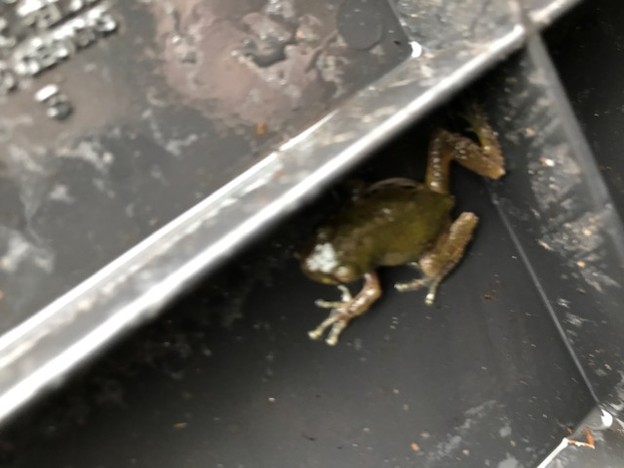
This frog was in the top of our compost bin in August, having not seen one like this before looked up some facts on it.
|